Exploring Creation with Biology
Published by Apologia Educational Ministries and written By Dr. Jay L. Wile and Marilyn F. Durnell
Exploring Creation With Biology is a biology course that is written to the student (the reader of the book), not to a classroom, and that is one of the things that makes this curriculum unique. The author recommends that this book be used during the 9th grade year. It is okay to use the book for the 10th grade year as long as that suits the student's course of study.
Contents on This Web Page
- 2nd Edition Schedule and Bookmarks
- 1st Edition Schedule and Bookmarks
- Exploring Creation with Biology Lab Forms
About the Printable Resources
Schedules/Lesson Plans: Editions 1 and 2: The schedules listed on this page are for the individual student. Co-op schedules are in the co-op section at donnayoung.org.
Bookmarks: Editions 1 and 2: Exploring Creation With Biology has a lot of vocabulary. The large amount of vocabulary is what inspired me to make bookmarks for these courses.
Lab Sheets: I've linked my lab sheets at the bottom of this page at The Lab
Lists: I've included text files for the following: Edition 2 Table of Contents, Editions 1 and 2 Supply Lists, and Edition 2 List of Experiments.
Off-site Resources
I happened upon two books that were nice to have on hand, and they are The Zoology Coloring Book by Lawrence M. Elson and The Botany Coloring Book by Wynn Kapit / Lawrence M. Elson. The zoology book was the more helpful of the two because it contains all of the different animals grouped by phylum and it has drawings of most of the animals discussed in the text. However, I am not saying that you have to buy these books. The books are simply nice to have for the additional labeled drawings.
Blogs: If you are going to teach Exploring Creation With Biology, be sure to read Michelle Goodrich's articles about her local co-op classes at https://appliejuice.wordpress.com/apologia-biology/
Important: Instructor, be certain to read "Teacher's Notes" in front of the Solutions and Tests book. Students and instructor should read the "Student's Notes" in front of the text book.
Legend:
 Text file
 Acrobat PDF
 Word DOC
 XLS
XLS
 Web Page
 Compressed file [ZIP]
 Schedule and Bookmarks for Exploring Creation with Biology 2nd Edition
First some text files:
Table of contents | Supply List | List of Experiments
2nd Edition Schedule
by Robin Rock
Schedule for Edition Two
Schedule for Edition Two
2nd Edition Vocabulary
2nd Edition Bookmarks with Vocabulary
Vicki Nave updated the vocabulary for the second edition and I made bookmarks with the vocabulary.
Bookmarks Modules 1, 2, 3 |
Modules 4, 5 |
Modules 6, 7 |
Modules 8, 9, 10 |
Modules 11, 12, 13 |
Modules 14, 15, 16
2nd Edition CD-Rom Schedule
by Tammy Gisel
Topics are linked to Drive F
DOCX: Linked to Drive F:\ - Schedule for Exploring Creation with Biology, 2nd Edition
Schedule and Bookmarks for Exploring Creation with Biology 1st Edition
Supply List 1st Edition Vocabulary
1st Edition Schedule
by Donna Young
Schedule for Edition One
See revision notes
[HTML] Supplies List - this is a web page. See Supply List for text document
1st Edition Vocabulary
1st Edition Vocabulary
1st Edition Vocabulary [text file]
1st Edition Vocabulary Bookmarks
1,
2, 3 | 4, 5 | * 6 | 7, 8, 9, **10 | 11,
12, 13 | 14, 15, 16
Notes:
I recommend printing the bookmarks on card stock. Students can use the backs of the bookmarks for notes or to write the schedule.
*Module 6 has many terms. The bookmark
for module 6 is printed in two parts side-by-side. Cut the the parts out
as one piece, fold it in the middle and (optional) glue to make one bookmark for
module 6.
**Module 10 is under module 9.
GeoSarfari Desktop Users
GeoSafari Users Instructions
for making the cards and resources for the cards.
1st Edition Revision Notes
Parts that will be revised: Some of the figures to be drawn are not mentioned in the schedule: pages: 71-74 - draw and label a diagram of figure 3.2 (only the sketched part, not the photo) pages: 74-78 - do the same with figure 3.4 pages: 170-179 - draw figure 6.1 and figure 6.2 I allowed 3 days for every dissection, but it actually only takes one day to complete each one.
* Apologies for not yet revising the schedule. ~ Donna
The Lab
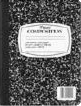 For the lab book, I recommend using a bound notebook instead of of loose paper or a word processor. We use composition books that can be found in most stores that sell school supplies. If you prefer loose paper, then below are some lab sheet forms.
Or below are Basic Lab Forms
2010 Exploring Creation with Biology Lab Forms
Each file has two pages as shown in the images. Mix and match the pages to suit the lab.
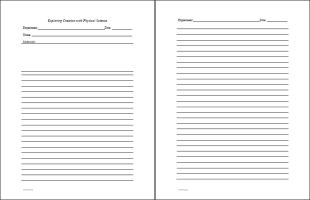
All Ruled Lab Form
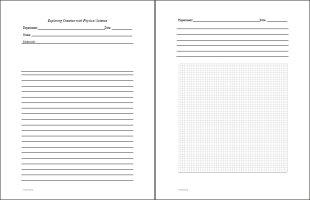
First Page Ruled, Second with Grid
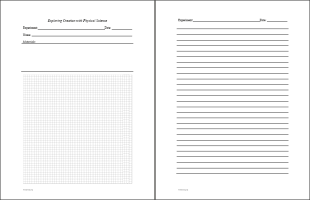
First Page Grid, Second Page Ruled
Both Pages Unlined
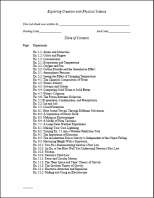
Table of Contents Form the the Lab Book
Experiments are listed- Based on Edition 2. The optional experiments are included in the list.
I recommend using the DOC file and reformatting the list in such a way that when the page numbers are added by the student, there is more height for the number.
Notes: May 2002
We are almost finished with our biology book. I can see that the schedule could use changes. One change is that it takes only one day to complete a dissection instead of the several that I allowed in the schedule. Each dissection takes more time than the previous one. We thought the fish was the most difficult because the dissection tools were inadequate for some of the cutting required. The fish scales slowed the cutting a great deal. We had to use sharp household scissors for some of the cutting. It took us around 2 hours to complete the fish dissection because of the cutting difficulties. An optional bonus of the fish dissection is the fish eyes. My son dissected the eyes and found the lenses, which he found very interesting.
The frog was the best dissection because we used the specimen with latex injected organs which made them easy to identify. Cutting the frog was not difficult except for the neck and shoulders of the frog. These areas were more difficult due to the bones present in that area.
Random Comments
Comment regarding specimens: I purchased our dissection specimens at the beginning of our school year. The dissections did not begin until months later. The worm was dry and dusty and a poor specimen. It is possible that it was bad in the first place or that we bought it too soon - I can't say which. I wonder if a freshly killed worm would make a good specimen if it is big enough?
The Drawing Assignments: My son found the labeled drawings that I required of him tedious but his grades improved by doing them.
Somewhere midway in the book I began to write the schedule of the module on the back of the vocabulary bookmark.
We started our leaf collection early so we could collect the spring leaves as well as the fully-grown leaves. Observing the trees when they 'wake up' in the spring helps me to identify them easier because there is more to go by such as their blooms and spring leaf color as well as emerging pests that live on the trees.
See also from Apologia's Knowledge Base this article: Two Example Biology Lab Reports
 Elsewhere at DY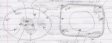
 About Keys
 Handwriting W/o Tears style handwriting lessons
 Comic Strip Templates
 Member's Login
 RSS Feed